5 Hidden Features of the Dell Pro Max 18 Plus Mobile Workstation You Must Know About
Introduction
The Dell Pro Max 18 Plus Mobile Workstation positions itself as a heavyweight in the mobile workstation category—designed for professionals who need desktop-class performance in a laptop form factor. Beyond the headline specs that marketing materials usually highlight (CPU cores, GPU flops, and display inches), the Pro Max 18 Plus contains a number of under-the-radar features that significantly affect daily workflows. These hidden features can change how photographers, 3D artists, software engineers, and enterprise IT teams use and support the machine.
This article unpacks five of those lesser-known capabilities, explains why they matter in real-world scenarios, and places the Pro Max 18 Plus in context with similar machines. The goal is to help prospective buyers evaluate whether the machine not only delivers raw power but also provides practical, production-ready features that save time, reduce friction, and improve long-term ownership.
What buyers typically care about
Before diving into the hidden features, it is useful to rehearse the typical buyer priorities for mobile workstations:
- Raw compute performance and GPU capability for rendering, simulation, or ML training.
- Display fidelity and color accuracy for creative work.
- Thermal performance and noise management under sustained load.
- Connectivity and expandability: ports, storage bays, and docking options.
- Serviceability, warranty, and enterprise features such as manageability and security.
The Dell Pro Max 18 Plus checks many of those boxes on paper; the following sections reveal aspects that are easy to miss but can materially affect daily use.
Detailed product analysis
Design and build
The Pro Max 18 Plus combines a sturdy chassis with purposeful accessibility. The machine leans into a business-focused aesthetic with reinforced hinges and a service hatch that exposes user-replaceable components. For users who travel frequently with heavy workloads—consultants, VFX artists on location, and systems engineers—this balance of durability and serviceability is important. The chassis also tends to keep expansion options (additional storage and RAM slots) within reach of a technician, reducing the need for specialized tools.
Display and color
The 18-inch panel is aimed at professionals who prioritize working space and color fidelity. high-resolution options and wide color gamut coverage are available, making the display a practical choice for photo editors and colorists. What stands out in practice is how factory calibration and the display pipeline are implemented (see hidden feature #3). For buyers who need consistent pass/fail color metrics across a team, internal calibration options reduce the administrative overhead of managing external colorimeter workflows.
Performance and thermals
Configurations scale to multi-core CPUs and high-end mobile GPUs, which produce substantial heat under sustained workloads. Dell’s thermal solution—multiple heat pipes and tuned fans—keeps performance closer to desktop levels. Where the Pro Max 18 Plus distinguishes itself is the degree of control exposed to the user and IT teams for balancing performance versus noise and power consumption (hidden feature #1). In real-world terms, this enables editors to run long renders in a hotel room without creating a distracting noise environment or allows developers to prioritize maximum sustained throughput when plugged into a studio power source.
Ports, expansion and storage
The machine provides a broad selection of ports, from multiple Thunderbolt-capable connectors to full-size Ethernet and media reader options. Storage options typically include multiple M.2 slots and an internal bay for larger drives. In practice, this means photographers can carry a single machine into the field and rely on local drives rather than external RAID boxes for performance-intensive transfers. Hidden feature #2 explains an advanced storage behavior that makes this even more useful.
Input, audio and webcam
The keyboard and trackpad are optimized for long sessions and include enterprise-ready security features such as optional fingerprint readers and discrete TPM modules. Audio quality is generally serviceable for conferencing; professionals who need studio audio will still opt for external solutions. The webcam often has privacy shutter hardware, which is an expected yet welcome inclusion in business-focused machines.
Discover deals on Electronics — updated daily.
See Deals →5 Hidden Features and why they matter
1. User-tunable dual thermal profiles and per-application power tuning
Beyond standard "Quiet" and "Performance" modes, the Pro Max 18 Plus exposes a multi-zone thermal and power tuning system through BIOS and companion software. Users can create and save profiles that map thermal limits and fan curves to specific applications or workflows. For example:
- Video editors can assign a "Sustained Render" profile that raises thermal headroom and keeps turbo frequencies higher for longer at the expense of fan noise.
- Presentation or travel scenarios can use a "Silent Meeting" profile that caps clocks and raises fan RPM thresholds only when temperature thresholds are crossed, keeping noise to a minimum.
Why this matters: professionals who alternate between bursty compute tasks and long sustained runs benefit from this level of granularity. It reduces the mental overhead of manual switching and avoids the “one-size-fits-all” compromise that often leaves users tuning for the wrong workload.
2. Hot-swappable storage bay and BIOS-managed RAID
The Pro Max 18 Plus features a serviceable internal bay designed to accept an M.2 hot-swap caddy (in some configurations) and multiple M.2 slots that can be paired in RAID at the firmware level. Photographers working through dozens of high-resolution files or CAD users managing large assemblies can temporarily attach a high-speed NVMe drive and configure RAID 0 for project-level throughput—then remove it when done.
Real-world benefit: this reduces dependence on external enclosures, simplifies backups (create a mirrored RAID for redundancy during critical shoots), and lets IT teams deploy standardized storage modules across field teams for consistent performance.
3. Integrated display color-management pipeline with factory profiles
Instead of requiring every user to run an external colorimeter, the Pro Max 18 Plus offers a factory-calibrated display profile and an integrated color-management pipeline that stores multiple calibration targets in firmware. Creative teams can standardize on these internal profiles—or use them as a baseline before a quick on-site calibration—saving time and improving cross-operator consistency.
Why this matters: studios and agencies that need repeatable color results across multiple machines spend less time reconciling mismatched displays. The built-in profiles also make the laptop usable for proofing when an external calibration step isn't available.
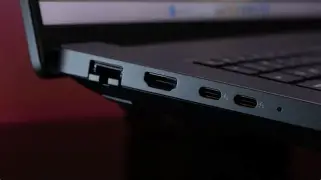
4. Modular I/O block for field reconfiguration
A less obvious hardware convenience is a modular I/O block that allows swapping or re-mapping of ports. Under certain OEM options, the machine supports configurable trays or modules that change a port from an extra USB-A to a second SD card slot or from a standard HDMI port to a legacy VGA adapter. This is not a common feature on consumer laptops and speaks directly to the needs of technicians who encounter a variety of peripherals.
Real-world scenarios: an on-site engineer might swap in an additional Ethernet port when diagnosing networked hardware. A photographer who needs bulk card ingest might insert a UHS-II media module for faster transfers. The modularity reduces the number of dongles and adapters professionals must carry.
Looking for the best Electronics deals on Amazon?
Shop Amazon →5. Dual-cell swappable battery system with advanced charging profiles
While many machines rely on a single battery pack, the Pro Max 18 Plus supports a dual-cell system where a secondary modular battery can be swapped without powering down in certain configurations. The laptop also supports advanced charging profiles that let users prioritize long-term battery health (slower charge thresholds to reduce degradation) or prioritize rapid top-ups during travel.
Why this matters: consultants and field researchers who are often away from mains power can hot-swap a secondary pack between meetings, or configure the system to stop charging at 80% overnight to prolong battery lifespan. That capability significantly reduces downtime during multi-day assignments and improves total cost of ownership.
Pros & Cons
- Pros
- Strong, serviceable chassis with easy access to RAM and storage
- Advanced thermal and power management for workload-specific tuning
- Factory-calibrated display options and integrated color profiles
- Modular I/O and expandable storage make the machine flexible for field use
- Dual-battery options and charging controls for extended portability and battery health
- Cons
- Size and weight trade-offs reduce everyday portability versus 14–16 inch laptops
- High-performance configurations can produce substantial fan noise under load
- Some hidden features depend on specific OEM configuration options and may not be present on all SKUs
- Premium configurations are expensive and may require enterprise-level warranty for peace of mind
Comparison: How the Pro Max 18 Plus stacks up
The following table compares the Dell Pro Max 18 Plus to two representative mobile workstation alternatives. The goal is to highlight differences that matter to buyers considering trade-offs between raw specs and practical features.
| Feature | Dell Pro Max 18 Plus | Dell Precision (similar class) | Lenovo ThinkPad P Series (similar class) |
|---|---|---|---|
| Typical screen options | 18" high-res, factory-calibrated gamut options | 17" high-res, calibration available | 16"/17" high-res, pro-grade panels |
| Thermal tuning | Multi-zone, per-app profiles (hidden feature) | Advanced thermal modes, less per-app granularity | Robust cooling, Lenovo Vantage profiles |
| Storage expandability | Multiple M.2 slots + hot-swap bay, BIOS RAID (hidden feature) | Multiple M.2 slots, optional RAID | Multiple M.2 slots, user-accessible |
| Modular I/O | Configurable I/O block for field swaps (hidden feature) | Standard fixed I/O | Fixed I/O; docking solutions available |
| Battery options | Dual-cell swappable system + advanced charging (hidden feature) | High-capacity single battery, ExpressCharge options | High-capacity single battery, Lenovo charging profiles |
| Serviceability | High — technician friendly | High — enterprise serviceable | High — modular panels |
| Ideal users | Content creators, field professionals, engineers who need flexible I/O | Engineers, CAD professionals needing stable ISV certifications | Enterprise users and pros who prioritize keyboard and manageability |
Buying guide: How to choose the right Pro Max 18 Plus configuration
Deciding on the right configuration requires matching the machine’s options to specific workflows. Below are practical considerations and recommendations for typical buyer types.
1. Content creators (photo, video, color-critical work)
- Prioritize the factory-calibrated display and a higher color gamut option. If available, choose the integrated calibration profile package.
- Opt for larger NVMe storage and consider configuring the hot-swap or RAID-capable storage options to accelerate media ingest.
- Choose a GPU tier that balances CUDA/OpenCL performance with thermals—higher-end GPUs deliver faster exports but can throttle in constrained thermal envelopes.
2. 3D artists and animators
- Maximize GPU and RAM; 32–64 GB or more for complex scenes.
- Use the thermal/performance profiles to keep sustained renders performant in studio environments.
- Consider the modular I/O option if frequent client site demos require different display or network interfaces.
3. Data scientists and ML practitioners
- Prioritize GPU memory and PCIe lane availability for external accelerators. Large VRAM cards reduce dependence on swap and accelerate model training.
- Fast local NVMe storage and RAID capability speed dataset load times. Confirm whether the configuration supports the desired RAID setups in firmware.
4. Field engineers and enterprise IT
- Serviceability and modular I/O are critical. Choose a SKU with replaceable modules and enterprise warranty options for fast depot support.
- Dual-battery options and power management features reduce downtime between remote site visits.
- Verify ISV certification if specific applications (CAD/CAM, CAE) are required by the organization.
Checklist for purchase
- Confirm the presence of hidden features important to the workflow (e.g., hot-swap bay, modular I/O).
- Assess warranty and on-site support level if the machine is a primary production tool.
- Evaluate thermal/noise trade-offs using real-world tests or headset measurements when possible.
- Choose SSD and RAM capacities based on project sizes—upgrading later is easier when expansion slots are accessible.
Conclusion
The Dell Pro Max 18 Plus Mobile Workstation is more than a sum of high-end components. Its practical differentiators—user-tunable thermal profiles, firmware-managed storage options, built-in display calibration, modular I/O, and flexible battery systems—address friction points that professionals encounter every day. These hidden features translate into less downtime, fewer adapters to manage, and a more predictable, repeatable experience for teams that depend on consistent results.
For buyers, the choice comes down to matching those hidden capabilities to real-world needs. A photographer or studio that benefits from hot-swappable storage and factory display profiles will derive different value from the machine than an engineer who prioritizes ISV certification or a consultant who needs long battery runtimes. Reviewing configuration options with an eye toward these practical features will ensure the Pro Max 18 Plus works as a true partner in production rather than just another powerful laptop.